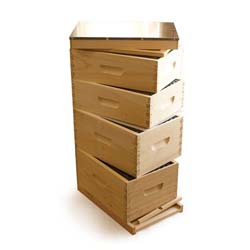
In my earliest months of beekeeping research, I started to learn of the different types or styles of beehives. Being uneducated on the topic, it seemed that all the beehives I ever saw were the same design. However, around the globe there are numerous hive set-ups. Each is fascinating in and of itself! But while I had been deciding on which type of hive I would start with, I came across several that came up frequently and piqued my interest. This blog is only a brief explanation about four hives that came to my attention while perusing the internet. In another article, I will talk more extensively about other types of hives.
Langstroth Hives
In the previous blog (My First Box of Honey Bees!) I explained how I came to own a Langstroth hive. I also listed the dimensions of the individual boxes and how beekeepers commonly add boxes to the top of the stack for honey collection or colony growth.
The interior of the individual boxes are fitted with frames that usually have a sheet of wax or plastic inside. This two-sided wax or plastic is called a foundation and is almost always stamped with a pattern of hexagonal shapes. The bees use the shapes as a pattern and continue to build their wax out until the familiar appearance of honey comb is observed. It is said that using foundations inside the frames saves the bees time and wax, as well as keeps the comb more uniform.
The Langstroth hive is the most widely used hive design worldwide. What led to this style being the most commonly used? According to The Beekeeper’s Bible, in the 1840’s American Lorenzo Langstroth was looking for an easier way to collect honey and work with his beehives. By adding movable frames and leaving a little crawl space for the bees in between frames (bee space), he found a practical solution to the aforementioned issues. In 1853, he began selling his invention to other beekeepers. These days, many beehives are modifications and adaptations of Langstroth’s findings.

Now let’s look at a hive I found alluring (and will hopefully build next). It’s called the Top Bar Hive.
The Top Bar Hive
Top Bar hives have been used for centuries, and offer a simple and natural approach to beekeeping. You can build them yourself. You don’t need special equipment for harvesting. It can be less disruptive to the bees during inspections. And you don’t have to lug big boxes around, making it easier on your back. You don’t have to stick to a specific size frame nor use foundation, as bars are lined across the top of the box, and the bees build the comb off the bars and downward (just as they would if left alone in nature).
The basic concept is that instead of building upward, the colony builds horizontally. The hive box can be shaped like an inverted triangle, or a long rectangular box (both on legs). Top Bar hive dimensions vary depending on the builder’s preference and they can come in many sizes- it’s whatever the beekeeper chooses to build. The box has a lid (often insulated and on hinges).
Bars are placed across the top, underneath the lid, and the bees build comb in their own way without using preset foundations as a model. As bees expand the colony and honey storage areas, they grow horizontally. Boards are used to control the size of the hive. The beekeeper does not lift and stack boxes, instead they pull out individual frames to make inspections. To harvest, the comb is simply cut off the top bar and dropped into a bowl or bin. Honey is harvested with the crush and strain method (another future blog). All very simple!

The Warre Hive
The Warre hive looks like a smaller version of a Langstroth. Often the boxes are only about 12”x12”, with a depth of 8.25 inches, and many have viewing windows. This smaller shape is meant to mimic bees in the wild who build their hives in hollow trees.
Like the Top Bar Hive, the Warre uses bars to guide wax building instead of specific-shaped wax or plastic foundations. New boxes are typically added beneath the existing hive (a process called nadiring). This is because if bees were in a tree, they would likely build downward as they build brood comb (baby bees). The abandoned upper comb is then used to store honey. When a beekeeper collects honey from the top boxes, they are less likely to encounter brood comb.
An advantage to this system is that wax is cycled out regularly instead of being reused, so it’s cleaner, and potential contaminants are less likely to accumulate. It’s said that Warre hives are low-cost and low-maintenance. This is another style that catches my eye because of the simplicity and natural approach.

Flow Hive
Flow hives are one of the “luxury” Langstroth adaptions. The boxes are the same size as a Langstroth, however the honey supers (boxes) are fitted with special frames that make collecting honey a breeze, without the use of extra equipment.
This hive was invented by father and son Cedar and Stuart Anderson in Australia as a way to harvest honey with minimal disturbance. They invented a frame made of clear plastic with the comb nearly built up, so all the bees have to do is fill the cells with honey and cap it over. At the bottom of the frame is a space that allows a tube to be inserted. With the turn of a “key”, the frame is adjusted, and honey flows out the tube and straight into your jar.
Because it’s essentially a Langstroth hive, this is not considered “hands-off” beekeeping. I do like the fact that the clear plastic allows for viewing the colony and the bees busily depositing honey stores. As with other hives, regular inspections, maintenance, and care are required.
On account of it being a specialized hive, the start-up cost is much higher and the specific parts can be more costly. At the time I looked into it, it was almost $300 plus shipping fees, just for the hive (no colony, queen or food stores). So even though I personally found that type of hive inviting (who doesn’t want to turn a key on an outdoor hive and get pure, clean honey?), I had to pass up this style of hive.
In the end, I viewed buying my first bee hive to buying my first car. Since I was going to be learning on this hive, I would start with a more common and affordable model. Before deciding on the type of car, I would learn about the engine and movable parts. At this point, a common basic box with a healthy colony was more important to me.