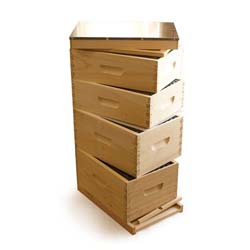
It’s April 2024 and I have determined that I’m going to become a beekeeper. I start looking on Facebook for a colony of bees. I decide that I would start with a Langstroth hive since they are the most common in my area. And one can easily buy Langstroth equipment online or at any given bee store.
While I was interested in constructing my own hives in the future, I wanted to start with a “kit” so I could follow that pattern down the road. Or later decide if I wanted to change to a complete different style.
Langstroth hives come in several box sizes that differ both in depth and the number of frames they hold. The most common configurations are 10-frame and 8-frame hives, though 5-frame nucleus (nuc) boxes are also widely used for smaller colonies or splits.
Langstroth boxes also vary in depth and are typically available as Deep (9 5/8″), Medium (6 5/8″), or Shallow (5 3/4″) boxes. Beekeepers often stack boxes of different depths to build the hive, and it’s generally best to use consistent frame sizes across your apiary for easier interchangeability.
Some beekeepers prefer using Medium boxes throughout the hive to reduce lifting weight, while others use Deep boxes for brood chambers and Medium or Shallow boxes for honey supers. A full Deep box can weigh over 50 pounds when filled with honey — something worth keeping in mind when choosing your setup.
I also learned that local bees are the way to go for better success rates. After two weeks of searching online, I visited a beekeeper who lived 7 miles away, and was selling a couple of colonies of bees.
I had no idea what I was looking for, but I wanted the “product” to at least look clean and healthy. The beekeeper took me to eleven well-maintained beehives in his yard and told me it was safe to walk up to them and take a look. The white hives were buzzing with late spring activities. I asked a few newbee questions and he kindly spent time answering them. When he found out I didn’t have a beekeeper jacket, he tossed in a hazmat suit for free, which I thought was a wonderful idea until I could purchase a beekeeper coat of sorts.
So, we agreed that for $250, I would buy one deep 10-frame Langstroth box with a new queen, honey, pollen, and a thriving colony. It seemed expensive to me at the time, but I had high hopes of rich rewards, and I could see that the seasoned beekeeper was experienced and could be trusted to sell me good product.
Now many may be questioning the fact that I only purchased one hive. And since that time, I have read that one should start with at least two hives. But I chose to just focus on one hive, and it’s what I could afford. For me, this ended up being a good decision, and I had successful first year (thanks to a robust and healthy colony).
I was nervous about transporting a beehive and really didn’t know how it would be done, but the beekeeper and his wife willingly brought the box to me one evening after dusk. The box entrance was stuffed with a rag. That’s when I learned that forager bees returned home before dark and wouldn’t get lost from their colony. He let me lift the box, and it was very heavy with honey. I bet it weighed close to 40 pounds! Kindly, he carried it to the table I had set up.
I was so excited to be starting this journey of beekeeping! I will admit, the more I researched, the more I realized how very little knowledge I had on the subject. I was a bit anxious and was troubled that I would kill these beautiful, tiny creatures. And I had read that a high percentage of new beekeepers quit within the first year. I absolutely dreaded the thought of finding myself among those statistics.
But the odyssey had begun, no turning back now!