I love to teach, and I really appreciate engaged students. For example, I taught SPIN and mountain bike classes for thirteen years in Colorado and Bolivia (even co-owning a SPIN studio). The greatest compliment I knew, was when a student became an enthusiast and later chose to become a SPIN instructor or avid cyclist of sorts. And I relish learning as much as I enjoy teaching. As an instructor, I loved taking courses for instructors from “mentors” and fellow SPIN devotees. So much is gained when we share with others.
And I meant to approach my beekeeping journey in the same enthusiastic way. I ask lots of odd/interesting questions, I do a lot of online searches, and I talk to other beekeepers. And I’ll try anything, if it’s not illegal, lol! I have to admit, I feel bad for the fellow who sold me the bees. I tried not to be a nuisance, but I did text him and his wife with a lot of questions that first month. They patiently explained things to me.
After reading that beekeepers often appreciate an extra pair of hands in the apiary, I reached out to David, my neighbor with 40 hives (the same one I originally bought honey from). He agreed that I could follow him around the bee yard, and we set a date when he would be out there checking honey in hives.
I arrived with my “hazmat” bee jacket (modified with duct tape), and cowboy-style netted bee hat (hey, it came with the bee kit I bought), leather gloves, jeans, and boots. I was a sight. David didn’t laugh (out loud), but offered me a spare beekeeper jacket that wouldn’t be so hot to work in. His jacket came with an attached netted hat, and I was grateful that it breathed so well.
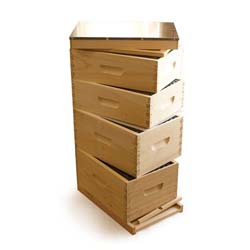
Out we went to the beeyard and quickly got to work smoking the hives, cracking the tops, adding empty medium honey supers to the towers that had full supers, and taking off full honey supers. At that time, David was collecting the boxes that contained mostly honey from Sourwood trees. It’s a specialty honey here in the Appalachians. So I learned to identify the light colored honey in a frame. Because it has a higher moisture content than your average honey, Sourwood is more watery and can ferment when bottled, if not dehydrated to the correct consistency. David had built a temporary dehydration room in his garage, complete with large fans, heaters, and a refractometer for checking moisture levels. This guy knows what he’s doing!
On subsequent visits, I got to participate in removing bees from honey-filled boxes that were ready to harvest. I saw what he used to keep the smoker going strong for longer time. I helped him requeen a queenless hive (he took a fully developed queen cell from another colony and put it in the queenless hive). I learned to identify wax moths on frames. I learned how the 16-frame electric extractor works. I saw where and how he caught swarms. I carried lots of honey boxes from the hives to the extractor room. I learned about different bee sting relief options (yes, I got stung on several visits), equipment for bottling honey, which local plants and trees bees love, how to freeze frames if suspect with pests or disease, and how to use Apivar strips and Oxalic acid for mite control.
I also learned the resilience of bees when one day a hive (3 or 4 boxes tall) had fallen over from a wind blast or animal raid. David picked it all back up, stacked it together, and moved on after explaining that the hive would be fine. Sure enough, on my next visit, the hive was buzzing away like nothing had ever happened. As long as the queen is alive, the colony can usually right itself.
In truth, I didn’t go over THAT often to help David in that first year, but each trip taught me heaps of valuable lessons and information I wasn’t going to get in a book. It really built my confidence to watch a beekeeper move deftly through the bee yard, unafraid to manipulate boxes, frames, and bees. I noticed that on the days I worked with my bees after being in David’s bee yard, I was much more self-assured handling the bees. Gotta love that hands-on learning!
Because I was just a “small potatoes business”, there were some methods and treatments I did not copy from David. He often said, ” I don’t know, but this is what I tried a year ago (or a few years ago)…” or, “I learned this from Bob Binnie…” and never expected me to do everything as he does. Plus, David himself humbly acknowledges that he still learns from other beekeepers. That’s the best kind of mentor, right? We learn from each other, but it doesn’t mean we do things exactly the same.
For instance, I wanted to try more natural methods for pest control, such as using essential oils. Looking back, I should have copied his aggressive treatment plan for Varroa, because my methods came back to “sting” me the following year. But it truly is how we learn.
I also ended up watching numerous videos and came to view the authors as mentors, even though I never personally met them. For instance, David Burns on YouTube has such a kind, non-judgmental attitude and has videos on everything bee you can think of. Seeing things on video is extremely helpful. Also, Jonathon at the Hive Doctor on YouTube has a calm demeanor and many years of experience that naturally comes out in the way he explains things. I had success trying essential oils after watching some of his videos. And I appreciate how Larisa from Beekeeping Made Simple (on YouTube) talks to beginners. She speaks like we’re important people too, and is very honest and frank even about her failures or mistakes as a beekeeper. I learned the crush and strain method for harvesting honey from her.
I did join a local beekeeping association in 2024, but it was late in the year, and I was unable to go on the nights they had meetings (it fell on a night I already have an important weekly meeting I can’t change). I had hoped to get a chance to talk to beekeepers from the association. Maybe this will be my year for that.
Recently, I sent a sample of dead bees to the North Carolina State University and remotely met someone from their apiary team. She explained some things she saw with my bees, and put me in touch with Lewis, a state beehive inspector. Lewis came out and checked my beehives (which thankfully aren’t diseased) and again emphasized the importance of mentoring with other local beekeepers and chapters. So the learning process continues!
In the meantime, I’m grateful for the hands-on learning experiences at David’s bee yard, and he’s grateful for the help. I never came away from his bee yard empty-handed. I got “paid” with honey, gear and equipment, farm fresh eggs, garden vegetables, and apples from the orchard. I know this is part of the “Appalachian” way in the South. People are so nice when you show just a little bit of kindness or take time to talk with them. But I feel like I got the bigger WIN out of this win/win mentorship. As they say in Bolivia, “Muchisimas (moo CHEE see mus) gracias!” to my mentors.