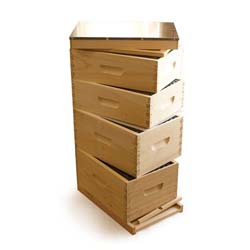
In previous blogs I’ve talked about the challenges to keeping a bee colony healthy. In my first season of beekeeping, I decided to use natural methods and wanted to keep things as simple as possible. My colony was large and active and I didn’t have to do much to keep pests at bay. I hoped we were remote enough to not “catch” diseases from other bees. Even still, I wanted to give them a little help.
Now the methods I used that first year are based on my personal philosophy of natural health. I’m a health enthusiast, but not an extremist (I love pizza and vanilla soft serve ice cream too much). I’m sure everything I did can be questioned or challenged regarding the correctness of my thoughts and approach. And not all of it is purely natural either. But at this age, I am also aware that learning is about trying new or different things for yourself. Often it’s how we reach that AH-HA moment, and understand WHY something needs to be done a specific way or in a certain order. In addition, every beekeeper tells me to just TRY things because you never know what will work this season. So bear with me as I relate my first season of beekeeping treatments.
In my personal life, I use essential oils where possible to replace synthetic chemicals (especially in fragrances). I invested in a kit of high-quality food-grade oils. I also limit my use of plastic, preferring glass, paper, and stainless steel for food products.
I watched videos of how to make mixes of essential oils for bee health. For example, one apiary I viewed does not use smoke when checking the hives. Instead, they made a calming mix of mints, thyme, lemongrass, oregano, and tea tree essential oils (diluted in water) to gently spray on the bees. I was impressed at how calm the bees stayed, so I tried that for a few months. In the end, the smoke worked best for me. However, I love the idea of using the essential oils because in addition to keeping the bees calm, it also keeps the pests, such as Varroa mites, at bay.
And I do spray a little essential oil mist at the end of most inspections to encourage the bees to clean each other off and calm them down after the disruptive home checkup.
I also made a concentrated mix of pure essential oils to use on cotton pads that I would leave inside the hive as bug repellent. I knew the concentration could repulse bees, too, if I wasn’t careful. But when I checked later the bees were carrying on as normal. So I continued with 2 or 3 cotton pads on the frame tops near the corners (which the bees would often carry out of the hive and throw on the ground).
Another place I used essential oils was when feeding the bees. A popular product I used is called Honey Bee Healthy. It’s fundamentally a mix of essential oils one adds to sugar water for feeding bees, or to make sprays. I saw a couple of videos on how to make a “homemade version” of Honey Bee Healthy using various essential oils, so of course, I tried that, too. My method was to make sugar syrup and add approximately 1/4 teaspoon of mixed oils to a quart of sugar water. Poke holes in the lid. Put the jar lid- side down on top of frames and put an empty box around it (called an eke) before putting the regular lid on top of the hive.
Finally, I used essential oils when removing filled honey frames for extraction. I took a clean old t-shirt and sprayed tea tree oil and rubbing alcohol (not so natural) on it and layed it across the top of my honeybox (once the lid was removed). I waited a few minutes and then removed one honey frame at a time, just brushing off a few bees per frame. The bees had retreated downward, but acted quite normal. Once I removed the honey frames, I also removed the t-shirt and put the box back together.
For small hive beetles (SHB), I used two beetle traps, called Beetle Blasters, per deep box between the last 2 frames nearest the edge. Because they are made of clear plastic, I could easily see how many beetles were being caught. One fills the traps with a trace amount of vegetable oil, and beetles fall in the little holes in the top and get stuck in the oil. But bees cannot fall in. I also learned that the SHB were usually found in the top box near the outer edges. If I paused to watch, I could see bees chasing and harassing beetles. I would help the bees and squash as many beetles as I could. Small hive beetles fly, so knocking them out of the box isn’t enough. They will fly back up and get inside the hive. But that first summer, my thousands of little girls, didn’t have trouble controlling the SHBs.
Speaking of plastic, I found out that many bee hives come with plastic foundation, which I initially opposed using because in my mind I thought, “How can plastic inside the hive be beneficial to a colony and the individual honey bees? Is that really natural?” So, I used wood frames and wax foundations. I wasn’t such a fanatic that I didn’t use fishing line to string up the wax foundations (or beetle traps)- there is a time and place for everything, eh? So there WAS a touch of plastic in my hive, but not much where the honey was being stored.
Next, after each inspection, I would use gin or vodka on a cotton ball to wipe down the top edges of the boxes before I stacked them back together (one of my mentors uses moonshine). I would also leave the cotton ball inside a corner where I had seen small hive beetles. I hoped this would inhibit tiny beetles and moths from entering the boxes and hiding out in corners.
In August of 2024, after removing the honey from the hive, I began a 4-week treatment of Apiguard, which is an extremely concentrated form of thyme oil made into a cake. This is a strong and natural chemical that kills Varroa mites. The cake is in a tray, and after peeling back the cover, the tray is placed in the center of a box on top of the frames. After a few days, I actually did see 5 dead Varroa on the front porch of the hive, so I knew it was working.
Lastly, another trick that actually can work as a type of “treatment” to prevent robbing during the fall, is to paint your bee hives during robbing season. I had painted my boxes earlier in the year, but I saw one of my mentors painting his boxes in robbing season, and what a great two-for-one idea! The boxes are getting prepped for winter weather. Meanwhile, the paint smell wards off robbing bees who are following the scent of honey.
By winter, these combinations of treatments seemed successful. I went into winter with numerous thousands of bees and a laying queen. While various pests were spotted, overall numbers were low and the healthy colony was able to fight off threats to the hive. It had been a busy year of treating bees!