My first hive inspection in the middle of May showed I had a robust and crowded colony. Until I understood more, I didn’t try to fix what wasn’t broken, so I didn’t change the three-inch entrance size on the hive, which resulted in a bustling landing pad (front porch) on all non-rainy days.

I wanted my bees to be at peace as they settled into their new neighborhood, so I actually didn’t do another inspection of the deep brood box for a month. But I was out there most days watching the bees. I noted a lot of yellow and golden pollen was coming into the hive. And something that surprised me was that the bees leaving the hive would fly way up in the air, like they were headed to the tree tops. I didn’t see heaps of bees on my flowering plants in the yard area. That’s when I learned that bees fly up to 4 miles away to harvest nectar (a few sources say more). They will go to the far sources first, and then, as nectar dries up or disappears, they harvest from the nearby flowers. Such smart little gals, right?
I had watched numerous videos about bees swarming if they pack out the hive and outgrow it. So, a week after my initial inspection, I added a medium honey super with 10 wax foundation frames. I didn’t do a lower box inspection, but I could see how crowded the hive was, albeit quite calm when I took the lid off. They were just too busy doing their jobs of storing nectar and pollen, and feeding “babies” (larva) to be bothered by me. One week later, I added a queen excluder between the brood box and honey super.
During June, I initially examined the honey super, not bothering the brood box. Two weeks after adding that super, almost all 10 frames were drawn out with wax, and 7 of them had a nice amount of nectar in the center. Soon after, five of the honey frames were filled and capped on both sides, and the rest of the frames in the honey box were drawn out with wax and partially full of nectar, ready to be filled completely. These girls were honey-making machines!
A month after my initial inspection of the 10-frame deep brood box, I finally did another inspection and found it to still be full of life and activity. The outer frames were brimming with honey and pollen. And seven inner frames were packed with food and brood. I saw eggs and larvae in all stages. There were no queen cells present and just a few small hive beetles.

By now, I had decided to go the natural route with pest treatments (not using synthetic chemical treatments), so I experimented with gin, vodka, apple cider vinegar, and essential oils to clean corners and edges, hoping to stave off moths, mites, and beetles. (I would leave the cotton pad in the corner of the hive box where the boxes came together.) And I utilized beetle traps with oil to keep the small hive beetle population down.
By mid June, the honey super was filled 8 out of 10 frames with capped honey, and I decided to add a 2nd deep box to the configuration. I moved three frames of healthy-looking brood to the new deep box and replaced those three with new wax foundation frames. In the new deep box, I placed those three brood frames in the center and then finished by adding seven new wax foundation frames around those three. Mind you, I made all these changes after researching and speaking with other beekeepers because I wouldn’t have had a clue on my own. ?
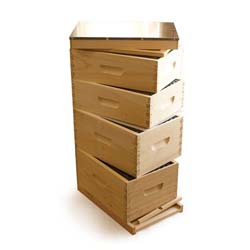
The set-up was now the original white deep box on the bottom. Next up was the new deep box with 3 frames of brood, pollen, and honey. Finally, I moved the medium-sized (nearly filled out) honey super to the top. My bee hive tower was starting to grow!

For new beekeepers, I know I’ve mentioned a number of things you may be asking in your head.
- What is a queen excluder?
- What is a queen cell?
- When and why does one change the entrance size on the hive?
- Don’t bees drink nectar from all flowers?
- How much honey does a bee make?
- How much honey will one hive produce?
- Just what is a swarm?
- What does it mean to draw out wax?
- And my God, what are small hive beetles, mites, and moths??
- And when are you going to spot the QUEEN already?
Excellent questions- I like how your keen mind thinks, young padawan! I had the exact same questions. Time and hands-on learning gave me the answers that I am happily going to share with you in this space. And for you, wise beekeeping “LIFERS”, may you get a good chuckle or reminisce about a similar experience you had.