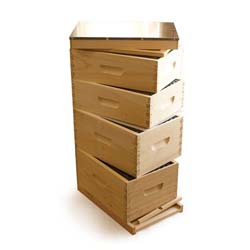
Starvation is a common—and very preventable—cause of winter colony loss. But here’s the cruel irony that every beekeeper should understand: hives can starve to death with honey still present in the hive, sometimes mere inches from where the cluster died. This can happen due to the cluster being too small/weak in a hive which is too big.
The winter cluster can move gradually across frames and upward to access nearby honey stores. But during extended cold periods, the tightly packed cluster cannot safely break apart to reach honey that’s too far away. Any bee leaving the warmth of the cluster risks freezing before it can return.
This is why store placement is critical. If honey isn’t located where the upward-moving cluster can access it—typically in the upper box directly above the cluster when overwintering in two brood boxes—the colony can starve while surrounded by untouched food. This upward movement pattern applies specifically to vertical, double-deep setups; single brood boxes and horizontal hives require different store-placement considerations because the cluster moves laterally rather than upward.
No matter your setup, the hive must match the colony’s population. Colony size to hive-space ratio is one of the most important, and most overlooked, factors in winter survival. A colony that’s too small for the space it occupies struggles to maintain heat, leaving the cluster weak, spread thin, and unable to move to distant stores. Conversely, a hive sized appropriately allows the cluster to stay dense, warm, and mobile enough to track food throughout the winter.
Wintering in a single brood box is perfectly valid—and often ideal—for smaller colonies. Many beekeepers even overwinter strong nucs in 5-frame boxes with excellent success. What matters isn’t the configuration itself but right sizing the space so the bees can maintain cluster strength and reach their stores as they move through winter.
This is why food assessment isn’t just about total honey quantity. Store location matters enormously. Understanding both how much food your bees need and where that food needs to be positioned can mean the difference between survival and loss.
Assessing Your Hive’s Food Stores
Three practical approaches help you evaluate whether your bees have adequate winter stores:
- The Heft Test – your quickest assessment tool.
- Stand at the back of the hive and lift gently from the bottom board’s rear edge—just enough to sense the weight. A hive with adequate winter stores feels surprisingly heavy. Deep frames full of capped honey weigh about 8-10 pounds each. With practice, you can estimate total stores within 10-15 pounds using the heft test alone.
- Visual Frame Inspection – for precise measurement.
- On a warm day (above 60°F), inspect whatever box or section of the hive contains the colony’s primary winter stores—whether that’s an upper deep in a vertical setup, the single brood box in a compact configuration, or the honey band adjacent to the cluster in a horizontal hive. Count frames as “full frames” only when they contain at least 80% capped honey. As a general guideline, a fully capped deep frame holds about 8–10 pounds of honey, and a medium frame holds roughly 5–6 pounds, though horizontal hive bars and smaller frames will vary by design.
- Avoid counting uncapped nectar as reliable winter food. Uncapped nectar contains too much moisture, which can ferment, freeze, or mold in cold weather. Bees cannot properly cure or move nectar during winter because low temperatures prevent them from evaporating moisture or reprocessing it. For winter survival, colonies need fully ripened, capped honey, which is stable, low-moisture, and immediately usable by the cluster even during prolonged cold.
- The Eight-Frame Rule – a quick regional guideline.
- A colony needs approximately eight deep frames of capped honey (or equivalent in medium frames) as a minimum for winter survival in most climates. This translates to roughly 65-80 pounds of honey and works reasonably well for moderate winter climates (zones 6-7). Northern beekeepers in zones 3-5 should plan for 10-12 deep frames equivalent (80-100 pounds) for longer winters. Southern beekeepers in zones 8-9 might succeed with 6-7 frames (50-60 pounds) for milder conditions.
*These numbers assume standard Langstroth equipment; top-bar or horizontal hives require equivalent total stores by weight rather than frame count.
Assess in late summer through early fall—typically August through September. This timing gives you the opportunity to supplement feed while temperatures remain warm enough for bees to process sugar syrup. Keep in mind winter bees will be created during this time and colony will consume lots of honey and pollen to raise winter bees. All these resources will have to be replenished before winter.
When and How to Feed
If your assessment reveals inadequate stores, supplemental feeding becomes necessary. The timing and method depend on when you’re assessing and your local temperatures.
Late summer and early fall (August-September) provides the ideal feeding window. Feed 2:1 sugar syrup (two parts sugar to one part water by volume), which bees readily convert into stored honey. Feed heavily and consistently until hives reach the target weight or temperatures drop too low for syrup processing.
Late fall (October-November) offers limited options. If daytime temperatures still reach 50-60°F regularly, 2:1 syrup feeding may work, though bees process it more slowly. Watch weather forecasts—don’t feed syrup immediately before cold snaps that prevent processing.
Pollen is the colony’s primary source of protein, essential for brood rearing, gland development, and building healthy winter bees with strong fat bodies. Natural pollen availability drops sharply in late summer and fall in many regions, which can limit a colony’s ability to raise the high-quality winter bees needed for successful overwintering. If your colony shows signs of low pollen stores—or if your region experiences a predictable fall dearth—feeding a pollen substitute can help sustain brood production. Pollen patties or dry pollen substitutes should be offered only when bees are actively raising brood and temperatures allow them to access and consume it; feeding patties during cold periods can attract small hive beetles or go unused. The goal is supplementing—not replacing—natural pollen so the colony enters winter with well-nourished bees and adequate protein reserves.
Winter feeding requires different approaches. Once winter arrives, liquid feeding becomes impractical. Emergency options include candy boards, fondant, or dry sugar placed directly above the cluster. Other articles in our Overwintering Guide address winter emergency feeding in detail.
Store Positioning: Location Determines Survival
As you assess or supplement stores, remember that positioning determines accessibility. Ideally, the cluster begins in the lower boxes – this is assuming you’re winterizing in two brood boxes, with heavy capped honey directly above for easy upward access through winter. As the cluster moves upward throughout winter consuming stores, it finds food consistently available.
Honey stored in the lowest boxes (below the cluster’s starting position) or in outer frames far from the cluster’s core has limited value during the coldest periods. If inspection reveals heavy outer frames but empty center and upper boxes, consider redistributing stores. Move heavy frames into the upper box’s center positions, where the cluster will naturally access them.
When Weak Colonies Need Help
Very weak colonies—typically those covering fewer than 5-6 frames of bees in early fall—face compounded winter challenges. Small clusters generate less heat, consume stores less efficiently, and have poor survival odds even with heavy feeding.
Many experienced beekeepers recommend combining weak colonies with stronger ones rather than attempting to winter them independently. Combining gives those bees a chance to contribute to a colony with better survival odds. If you choose to winter a weak colony independently, feed heavily, reduce hive space to match cluster size, and understand that survival odds are lower, even with your best efforts.
Moving Forward
Food assessment is empowering because it’s concrete and measurable. Learn the heft test. Count frames. Calculate your region’s needs. Feed when necessary. Position stores where your cluster can reach them.
A well-fed colony with properly positioned stores has eliminated the most common cause of winter death. Your bees now have the fuel they need to generate heat, maintain the cluster, and survive until spring’s return.
With strong food stores in place, you’ve built the first pillar of successful overwintering — giving your bees the energy they need to make it through to spring.